The windfall taxes on domestic crude oil production and fuel exports will generate close to $12 billion (Rs 94,800 crore) for the government in the remainder of the current fiscal while trimming profits of firms such as Reliance Industries Ltd and ONGC, Moody's Investors Service said Tuesday. On July 1, the government imposed windfall gain taxes on the export of petrol, diesel and aviation turbine fuel (ATF), and on the domestic production of crude oil. It has also mandated exporters to meet the requirements of the domestic market first.

The oil companies will meet on Friday for the review meeting on pricing in which petrol price could be increased by Re 1 and diesel prices by 50 paise by this weekend.
Indian Oil Corporation (IOC) on Tuesday reported halving of its March quarter net profit largely because of losses in the petrochemical business and shrinking margin after it announced a pre-election fuel price cut despite rising input costs. The net profit of Rs 4,837.69 crore in January-March compared to Rs 10,058.69 crore a year back and Rs 8,063.39 crore in the preceding October-December quarter, according to a stock exchange filing by the company.

'I am not an aspiration-oriented politician.' 'This is the time to redefine politics.' 'Politics of power is not real politics.'
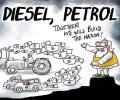
The Centre has garnered around Rs 2,500-3,000 crore in the first five weeks after it imposed a windfall tax on oil and gas companies for the export of fuel, Business Standard has learnt. It is likely that the government will continue with the one-time tax till the Indian crude basket is above $80 a barrel, sources said. The next review of the windfall tax on oil companies is early next week.

Reliance Industries Ltd on Thursday reported a 7.4 per cent rise in its December quarter net profit, as its retail business rebounded and telecom earnings rose. Its consolidated net profit of Rs 18,540 crore, or Rs 13.70 per share, in October-December - the third quarter of April 2024 to March 2025 fiscal (FY25) - compared to Rs 17,265 crore, or Rs 12.76 a share, in the same period a year back, according to a stock exchange filing by the company.

The Bharatiya Janata Party on Tuesday alleged that the government's contention of oil companies going insolvent if prices of petro products were not increased was wrong and backed its argument by providing profit figures of the three oil PSUs in the country.

Higher inflation has again become a matter of concern for fast-moving consumer goods (FMCG) companies. After prices of commodities like sugar and wheat moved higher and stabilised at those levels, the crude oil too surged, adding to FMCG firms' worries. Besides, a dry spell in August in the ongoing monsoon season impacted rural demand.

Dividends paid by central public-sector enterprises (CPSEs) in 2024-25 are set to be the highest ever, with the government receiving 69,873 crore so far. A government official said he was hopeful the receipts would touch 70,000 crore in the last week of the financial year.
Major edible oil companies, including Adani Wilmar and Ruchi Soya, have reduced the maximum retail price (MRP) of their products by 10-15 per cent to provide relief to consumers, industry body SEA said on Monday. The prices have been reduced by Adani Wilmar (on Fortune brands), Ruchi Soya (Mahakosh, Sunrich, Ruchi Gold and Nutrella brands), Emami (Healthy & Tasty brands), Bunge (Dalda, Gagan, Chambal brands) and Gemini (Freedom sunflower oil brands), it said. OFCO (Nutrilive brands), Frigorifico Allana (Sunny brands), Gokul Agro (Vitalife, Mahek and Zaika brands) and others have also reduced prices, it added.

From the 30-share blue-chip pack, IndusInd Bank, NTPC, UltraTech Cement, Sun Pharma, Axis Bank, State Bank of India, Tata Steel, Power Grid, Adani Ports and Kotak Mahindra Bank were among the major laggards. Tata Consultancy Services jumped nearly 6 per cent after the IT services company reported an 11.95 per cent jump in the December quarter net profit to Rs 12,380 crore. Tech Mahindra, HCL Tech, Infosys and Bajaj Finserv were the other big gainers.
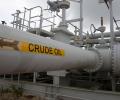
The basket of crude oil that India buys has hit a decade high of $121 per barrel, but retail selling prices of petrol and diesel continue to remain frozen. The Indian basket on June 9 touched $121.28, matching levels seen in February/March 2012, according to data available from the oil ministry's Petroleum Planning and Analysis Cell (PPAC). As per the PPAC, the Indian basket of crude oil averaged $111.86 per barrel between February 25 and March 29 - the immediate period after Russia's invasion of Ukraine sent oil on fire.

Billionaire Mukesh Ambani-promoted Reliance Industries Ltd (RIL) on Tuesday became the first listed company to hit the Rs 20 lakh crore market valuation mark. The market heavyweight's stock jumped 1.88 per cent to its record high of Rs 2,957.80 apiece on the BSE. It finally settled at Rs 2,928.95 per piece, up 0.90 per cent on the bourse.

State-run Indian Oil Corporation (IOCL) reported a weak performance in the fourth quarter of FY24 (January-March 2024), and the turmoil in the energy market indicates it could endure another lacklustre quarter. The oil marketing company (OMC) reported an Ebitda of Rs 10,400 crore, down 27 per cent year-on-year (Y-o-Y) due to weak reported gross refining margin (GRM) of $8.4 per barrel in Q4FY24, which was almost half the consensus expectation of $15 per barrel.

Share prices of both upstream and downstream public sector oil companies fell up to two per cent on Monday. Even Essar Oil, a private fuel retailer, fell 1.50 per cent on the Bombay Stock Exchange.

The Oil prices have surged and surpassed $85 per barrel after several oil producer countries announced surprise cuts in production, TASS Agency reported. According to the Russian News Agency, this is the first time since March 7 that the price of futures contracts of Brent crude oil surged. The price of futures contracts of Brent crude oil for June 2023 delivery on London's ICE surpassed $85 per barrel.
Oil-to-telecom conglomerate Reliance Industries Ltd (RIL) has surprised the street with a better than expected performance in its oil-to-chemicals (O2C) division in October-December 2024 (Q3FY25). RIL executives attributed it to favourable feedstock sourcing and higher volumes. However, they also listed cost optimisation and other measures.

The market capitalisation of BSE-listed companies soared to an all-time high of Rs 406.52 lakh crore on Monday thanks to a rally in equities where the BSE Sensex climbed over 1 per cent. The 30-share BSE Sensex rallied 941.12 points or 1.28 per cent to finish at 74,671.28. During the day, it zoomed 990.99 points or 1.34 per cent to 74,721.15.

The government has brought back the windfall profit tax on domestically produced crude oil after international prices firmed up while the levy on export of diesel has been cut to nil, according to an official order. The levy on crude oil produced by companies such as Oil and Natural Gas Corporation (ONGC) is now Rs 6,400 per tonne with effect from Wednesday, the order dated April 18 said. At the last revision on April 4, windfall tax on domestically produced crude oil was cut to nil as international oil prices dipped below $75 per barrel.

From the 30 Sensex companies, Zomato, Tata Motors, IndusInd Bank, Asian Paints, Bajaj Finance, Maruti Suzuki India, Adani Ports, Hindustan Unilever, Reliance Industries, Bajaj Finserv, UltraTech Cement and Infosys were among the laggards. In contrast, State Bank of India, ICICI Bank, Tata Steel, NTPC, Tata Consultancy Services, PowerGrid, Kotak Mahindra Bank and Sun Pharmaceuticals were the gainers.
The 18 companies sanctioned include Marshall Islands-registered Changtai Shipping and Motionavigations Limited and UAE-based Indo Gulf Ship Management.

After Chennai, it is Coimbatore, Madurai, and Tiruchirappalli, that are emerging as manufacturing hubs. Coimbatore is India's top Tier-II city in terms of the number of GCCs, according to a report by Cushman & Wakefield.

'I would not suggest buying these stocks in the dip, as the upside in profit is dented without a safety net for a rainy day.'
Reliance Industries Ltd on Friday reported a 9 per cent rise in its December quarter net profit as a planned maintenance-induced weakness in oil business earnings was offset by stability in retail and telecom verticals. The oil-to-retail-to-telecom conglomerate's consolidated net profit of Rs 17,265 crore, or Rs 25.52 per share, in October-December - the third quarter of the current 2023-24 fiscal - was 9.3 per cent higher than Rs 15,792 crore, or Rs 23.19 a share, earning a year back, according to a company statement. Quarter-on-quarter, the profit was lower when compared to Rs 17,394 crore earnings in the preceding three months ended September 30.
Notwithstanding the windfall tax placing a cap on profits, oil and gas producers like Oil India (OIL) and Oil and Natural Gas Corporation (ONGC) have done well in the October-December quarter (third quarter, or Q3) of 2022-23 (FY23). ONGC faces the drag of poor results from its subsidiary Hindustan Petroleum Corporation, and in comparative terms, OIL is better off. Standalone net sales in Q3FY23 stood at Rs 5,900 crore - up 57 per cent year-on-year (YoY), up 2 per cent quarter-on-quarter (QoQ).

'Could the impending new crisis, vibe coding, similarly create not a disaster like what befell Indian handlooms during the Industrial Revolution but another opportunity like what the Y2K crisis created?' asks Ajit Balakrishnan.

Vedanta's Cairn Oil & Gas on Thursday announced the appointment of Nick Walker as the new chief executive officer (CEO) of the company. In a statement, the company said the appointment is effective January 5. "Before this appointment, Walker was president and chief executive officer at Lundin Energy, one of the leading European independent E&P companies," it said.

Here is a list of Q & As to explain these issues and implications of the US move.

In order to facilitate purchase of crude oil from Iran, the Finance Ministry has issued a notification exempting payments made in Indian rupee for such imports from any local tax.

The commerce ministry is working on different scenarios to assess the possible fallout of reciprocal tariffs to be imposed by the US administration on April 2 on its key trading partners including India, sources said. US President Donald Trump has said that April 2 will be 'Liberation Day' as he plans to announce tariffs or import duties to bring down America's trade deficit, and promote the country's manufacturing.

The satta market is accepting bets on how many times Modiji will mention Nehru at his election rallies, says A Ganesh Nadar with a wink.
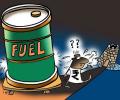
India has taken up the issue of high oil prices with producer nations and OPEC, demanding affordable rates, Minister of State for Petroleum and Natural Gas Rameswar Teli told the Lok Sabha on Monday. Petrol and diesel prices have shot up to record highs across the country after relentless price increases since early May. Petrol is retailing above Rs 100 a litre in more than a dozen states.
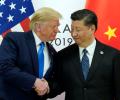
Trump spoke approvingly of his recent telephone conversation with Xi Jinping. This could indicate the possibility of America and China reaching some level of tactical accommodation, which would not be good news for India, points out Ambassador Shyam Saran, a former foreign secretary.

From the 30-share blue-chip pack, Bharti Airtel, Power Grid, Bajaj Finance, Nestle, Mahindra & Mahindra, Reliance Industries, Asian Paints, IndusInd Bank, Hindustan Unilever and HDFC Bank were the biggest gainers. Bajaj Finance climbed nearly 2 per cent after the company reported an 18 per cent increase in its consolidated net profit to Rs 4,308 crore for the December quarter.
Venezuelan national oil company Petroleos de Venezuela S A (PDVSA) will help Oil India Ltd exploit about $2 billion worth of heavy crude oil in Baghewala oil field in Rajasthan.

The October-December quarter (Q3FY25) results of fast moving consumer goods (FMCG) major Hindustan Unilever (HUL) indicated weak demand, with urban growth muted and rural showing recovery. Consolidated revenue grew by 1.6 per cent (volume was flat) to Rs 15,818 crore, due to price hikes. Prices of key raw materials such as palm oil and tea remained elevated, leading to compression of gross margin.
